Supergirl (2026) – The Film I Could Watch 100 Times Over
Our experiences don’t just shape our lives—they shape which stories that speak to us.
Supergirl (2026) for me was the perfect movie start to finish. I could watch this movie on repeat all day. If there’s any definition of a movie that works for me it’s that one. I’ll buy the 4K Blu Ray Disc when it comes out brand new at full retail. This movie truly worked for me and has cracked my list of top movies of all time.
This piece is not a general movie review or recommendation, but rather an explanation of how this movie worked for me. Film theory talks about spectatorship as exploring how viewers engage with movies, interpreting meaning and emotional responses. People decode films based on their own identities and backgrounds (Beverly Boy Productions, 2025). Superman Lore is part of what exists in most people’s minds already – in most people’s backgrounds.
Most people know the lore of Krypton from Superman – the planet is destroyed and Superman / Supergirl are evacuated and the last survivors of Krypton, give or take a few universe reboots and bad guys from the Phantom Zone, the prison where criminals from Krypton are banished to and in most storytelling, somehow escape from and cause havoc. From the start the audience knows the main character is a survivor and alone.
In the movie, Supergirl is partying for her 23rd birthday with her dog Krypto. She is on planets without a yellow sun – the result is she can feel the effects of partying because she doesn’t have her powers which come from exposure to a yellow sun. She comes across Ruthye, who survives the murder of her family by a character named “Krem” of the “Brigand”.
Ruthye asks for Supegirl’s help and is initially turned down, however when Krem shoots Krypto with a poison dart and the result is that Krypto has 3 days to live, Supergirl goes in pursuit of Krem to get the antidote that is on his person, while Ruthye accompanies. This is a lot of narrative but well paced for a pause.
This is where I have to pause and give the narrative and the film theory credit together. I think anyone who has been through trauma early in life – as clear with Supergirl – understands the partying – the need to actually feel something whether positive, negative, or intoxicating. When Krypto gets shot, Supergirl faces the possibility of yet another loss after the loss of her family. When one goes through trauma, the fear of another loss can be unbearable and often justifies going to any length to prevent it.
When one goes through trauma, the bond with an animal can be strong as they can be loyal and symbolize someone that won’t leave you like you’ve been left before. When Krypto is poisoned, the film isn’t simply threatening a pet, it’s threatening one of the few relationships that Supergirl believes will never voluntarily leave her. I think the drive of Supergirl to go on what is the movie’s main adventure is something those who have been through trauma can understand. It also breaks into film theory.
Film theory describes this as active spectatorship—the idea that audiences do not simply receive a film’s meaning but actively construct it through their own identities, experiences, and memories. (Beverly Boy Productions, 2025) In my own case, I am an active audience member. I lost my biological family through war, becoming an orphan and being evacuated to another country as my home city fell. (PSU.Edu, 2019).
Over the years I have also outlived much of my adoptive family and experienced the loss of friends through alcoholism, fentanyl overdose, and gun violence. Loss has been a recurring part of my life, and in response I have spent years rescuing cats, finding purpose in protecting vulnerable lives. It’s those experiences I bring as an active audience member in spectatorship – they shape not only what I see, but what the story means to me.
Because of those experiences, Supergirl’s decisions made emotional sense to me in ways they might not for every viewer. Someone else may simply see a superhero adventure. Through the lens of my own experiences, I saw someone who had already endured profound loss and was terrified of losing one more companion. That is not necessarily the film’s only meaning—it is the meaning I constructed as an active audience member bringing my own history to the viewing experience as the film progresses to an even bigger crisis.
Supergirl and Ruthye learn the location of Krem and his forces, subsequently also learning Krem has been abducting young women to be bridges to repopulate his people. Supergirl eventually encounters an entire group of girls imprisoned. At the same time Ruthye is bent on killing Krem as revenge for his execution of her family. Supergirl has a lot on her plate she can see needs intervention.
When you’ve been through something, you can recognize when things are wrong, off, or don’t seem right. In this case, Supergirl knows what she has to do in terms of the imprisoned girls and can emphathize with where Ruthye’s at emotionally. Not every viewer will interpret those moments the same way I did, because we don’t all bring the same experiences into the theater.
Looking back on the film, I realized something else connected with me. Much of my own life has revolved around rescue—whether rescuing cats, advocating for vulnerable people, or helping others navigate difficult circumstances. Supergirl’s journey is not simply about defeating a villain. It is a story driven by rescue. She repeatedly chooses to protect those who cannot protect themselves. That value has become one of the defining themes of my own life, and it may explain why this story resonated with me so deeply.
I think the movie works for active audience members who have ‘been through stuff’. James Gunn and Peter Safran deserve credit for bringing this film to the big screen. Ana Nogueira has done a great job of telling a growth journey and showing the strength that comes from our individual experiences. Craig Gillespie did an amazing job at directing this film with pacing that lets the audience both immerse yet process without being taken too far too fast. Milly Alcock gives an amazing and believable performance of someone on a what is a difficult journey that many of us go through.
This is a deep film and to me at least, a job well done by all involved. It’s one I’ll never forget.
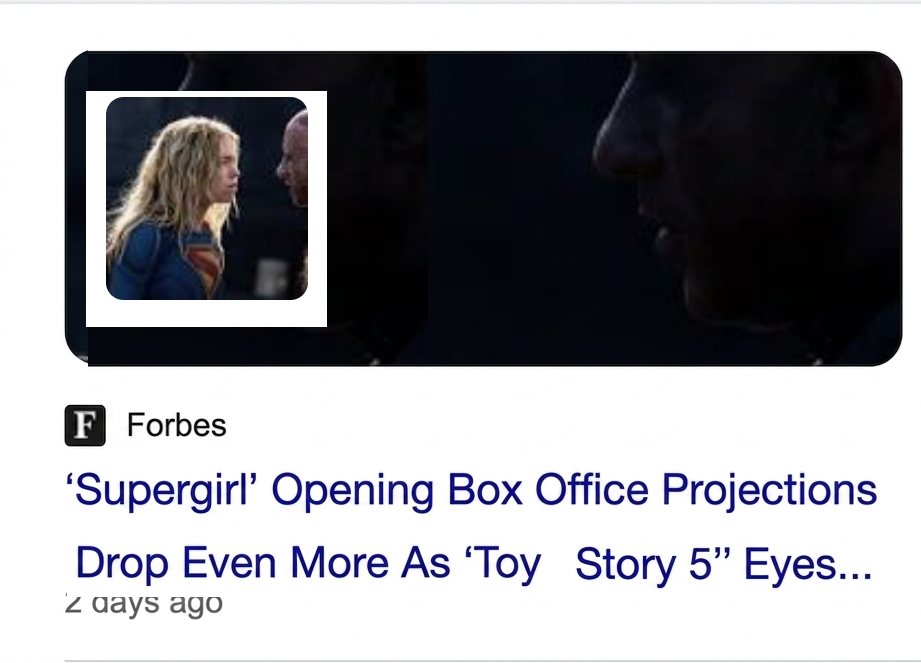

In the end, Supergirl hasn’t had good box office projections, hasn’t reviewed well, and is up against Toy Story 5 it’s opening weekend but what it has done well for me at least is connected. I was engaged from the first minute to the last minute of the film. It reminds me of Masters of the Universe in a sense – the success of that film wasn’t the box office or the reviews, it was the audience’s desire to return to Eternia, revisit it’s cast of characters and go on one more adventure with He-Man.
For me Supergirl took me on an adventure very familiar to me in my own life and I truly can thank Milly Alcock, Ana Nogueira, Craig Gillespie, Peter Safran, and James Gunn for taking me there and back.
If this essay has a message beyond one superhero movie, it is this: pay attention to the stories that move you. They may reveal something about you that you haven’t yet put into words.
For me, Supergirl wasn’t simply a story about a superhero defeating a villain. It became a story about surviving loss, protecting those we love, and discovering that painful experiences can produce empathy, courage, and a willingness to rescue others.
Your story may be different. The film that changes you may not be Supergirl at all. But somewhere there may be a book, a movie, a song, or a television series that feels as though it understands something about you before you understand it yourself. Rather than dismissing that reaction, be curious about it. Ask why it affected you. The answer may tell you as much about your own life as it does about the story itself.
Sometimes we don’t simply discover ourselves through experience. Sometimes we discover ourselves through the stories that experience allows us to understand.
Works Cited:
Beverly Boy Productions. (2025, December 12). What is spectatorship in film theory? https://beverlyboy.com/filmmaking/what-is-spectatorship-in-film-theory/
Appelman, H. (2019, April 29). Graduating World Campus student wants to help others as he has been helped. Psu.edu; Penn State News. https://www.psu.edu/news/academics/story/graduating-world-campus-student-wants-help-others-he-has-been-helped
My Lifetime Top 10 Movie List:
Star Trek II: The Wrath of Khan (1982) (VHS, Laserdisc, DVD, Blu Ray, 4K)
Transformers: The Movie (1986) (VHS, Laserdisc, DVD, Blu Ray, 4K)
Supergirl (2026) (New!) (The first film to crack the top 10 list since 2010’s Alice in Wonderland)
Bebe’s Kids (1992) (DVD / Blu Ray)
Alice in Wonderland (2010) (DVD / Blu Ray)
Polar Express (2004) (DVD / Blu Ray /4k)
Jetsons the Movie (1990) (VHS, Laserdisc, DVD, Blu Ray)
Up (2009) (DVD, Blu Ray)
Batman: Mask of the Phantasm (1993) (Laserdisc / DVD / Blu Ray / 4K)
The Dream Team (1989) (VHS / Laserdisc / DVD / Blu ray)